

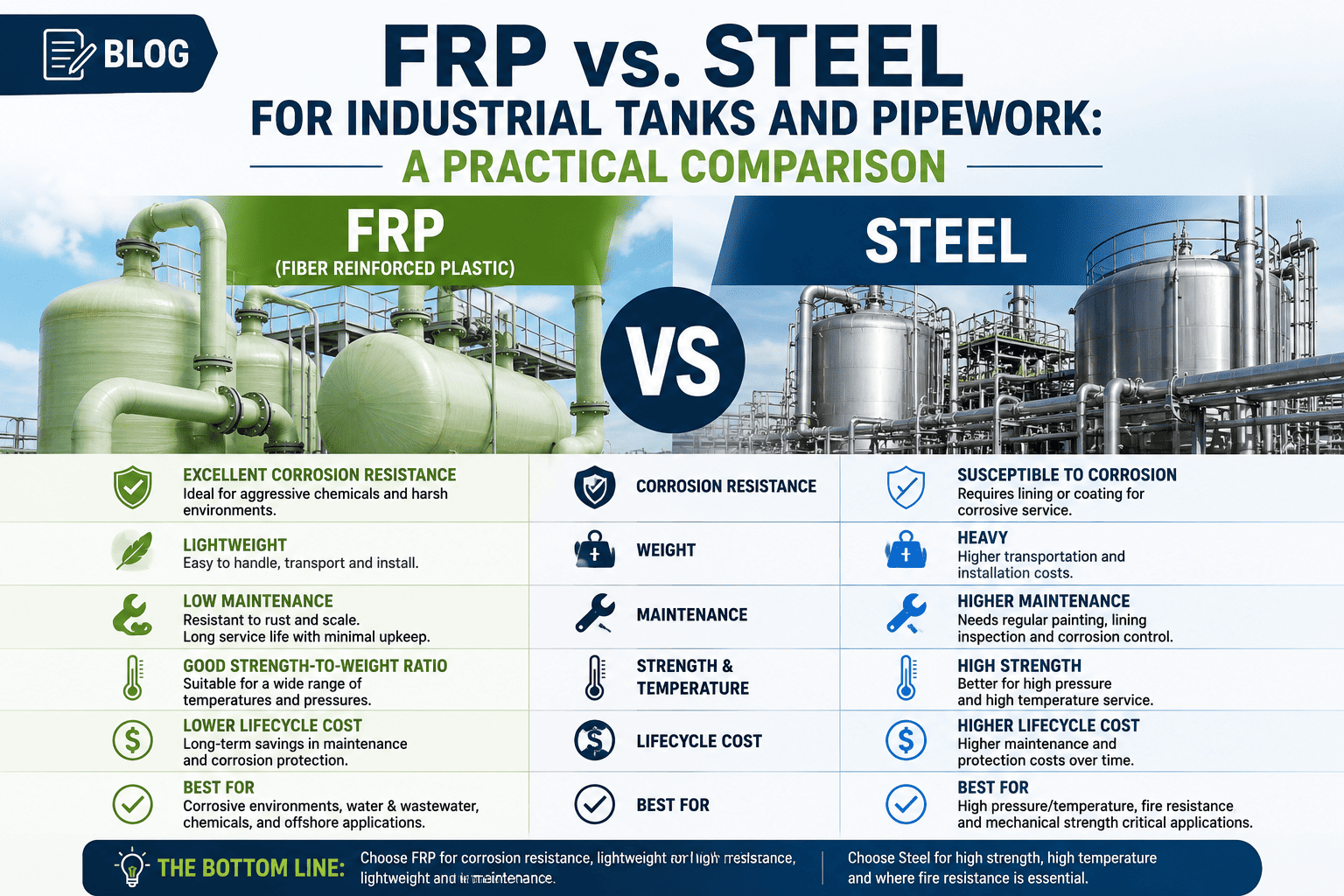
The choice between FRP (Fibre Reinforced Plastic) and steel for industrial tanks and pipework comes up in almost every water treatment, chemical processing, or industrial ventilation project. It’s rarely a simple call.
Both materials have genuine advantages in the right application. The problem is that material selection decisions are sometimes made on purchase price alone — and that can result in a steel tank corroding in a chlorinated environment within three years, or an FRP vessel being used in a high-temperature application where it simply doesn’t belong.
Here’s a working comparison.
Corrosion Resistance — Where FRP Has a Clear Advantage
Steel is strong, weldable, and familiar. It also corrodes in the presence of moisture, acids, alkalis, and chlorinated compounds. In a water treatment plant handling sodium hypochlorite or ferric coagulants, unlined carbon steel is not a viable option. Even stainless grades have limits — austenitic stainless in chloride environments is susceptible to stress corrosion cracking.
FRP doesn’t corrode. That’s not marketing language; it’s a material property. Properly specified and manufactured GRP/FRP tanks and pipework can handle aggressive acids, alkalis, solvents, and seawater with minimal degradation over a service life that routinely exceeds 20 years.
For chemical storage, scrubber bodies, ductwork handling corrosive fumes, and wastewater containment, FRP is usually the right answer from a corrosion standpoint.
Mechanical Strength and Pressure Ratings — Where Steel Remains Dominant
For high-pressure service, steel wins. Pressure vessels operating above a few bar, high-temperature service, or applications involving significant mechanical loading — impact, vibration, thermal cycling — are typically better served by steel.
FRP has good tensile strength along the fibre direction but lower impact resistance and is susceptible to damage from point loads and abrasion. It’s also temperature-limited; most standard FRP materials have a working temperature ceiling of around 60–80°C, though specialist resins push this higher.
For ASME-coded pressure vessels, steel is the practical standard. For ambient-temperature, lower-pressure chemical storage and distribution, FRP often outperforms steel over its service life.
Learn more about our FRP tanks, GRP pipes and scrubbers
Weight and Installation
FRP is significantly lighter than steel — typically 1/4 to 1/3 of the weight for equivalent structural applications. That difference matters in a few specific scenarios: offshore installations where topside weight is a constraint, elevated platforms where structural loading is limited, and large-diameter tanks where crane capacity affects installation cost.
Lighter weight also means lower transport cost for large units. A 3-metre diameter FRP tank weighs considerably less than its steel equivalent, which affects logistics from fabrication facility to site.
On the flip side, FRP components require more care during installation. They can’t be cut and welded on site the way steel can. Joints use adhesive bonding or mechanical flanging, and site modifications require specialist knowledge.
Total Cost of Ownership — The Number Most Quotes Don’t Show You
Steel is often cheaper to procure initially. FRP tanks and fittings carry a higher unit cost in most cases. But the comparison that matters for procurement decisions is total cost over the service life, not unit price.
A carbon steel tank in a corrosive duty application may require internal lining (itself a cost), periodic lining inspection and repair, and eventual replacement within 8–12 years. An equivalent FRP tank in the same duty, if correctly specified and manufactured, may serve 20–25 years with minimal maintenance.
The maths change significantly when you factor in maintenance access cost, production downtime during replacement, and the operational disruption of a tank failure. Most engineering managers who’ve been through a tank replacement on a live plant don’t want to do it again on an avoidable schedule.
Where Rubber Lining Fits In
For existing steel vessels going into corrosive service, or for applications where the structural integrity of steel is needed but chemical resistance is also required, rubber lining is often the practical answer. We carry out rubber lining on vessels, tanks, and pipework as a standalone service.
Lining extends the service life of a steel vessel in corrosive service — effectively giving you the structural properties of steel with a chemical-resistant inner surface. It requires periodic inspection and eventual re-lining, but it’s a viable and cost-effective solution for many applications.
Making the Right Call
The honest answer is that there’s no universal winner. The right material depends on the service fluid, operating pressure and temperature, installation environment, maintenance capability of the end user, and budget structure.
What we’d suggest: don’t make the decision based on what the last project used, and don’t delegate it entirely to the fabricator without input from your process engineer. Get clear on the service conditions first, then evaluate material options against those conditions.
We fabricate both metallic and FRP/GRP components in-house. If you’re weighing up options for a specific application, we’re happy to give you a technical view on what we’d recommend and why — without obligation.
▶ Discuss Material Options for Your Project