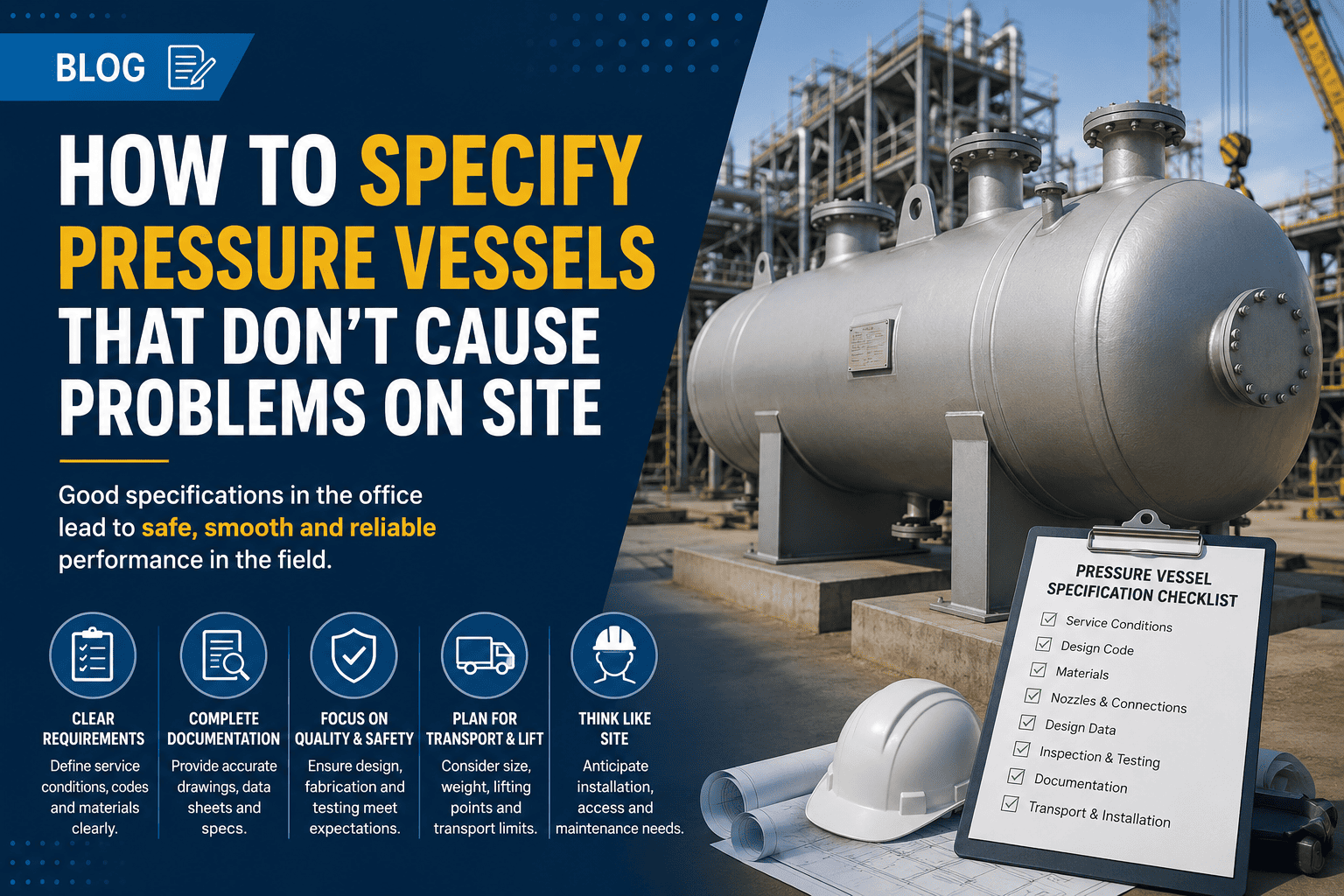
Most pressure vessel problems don’t start on the shop floor. They start earlier — in an enquiry document that’s missing half the information a fabricator actually needs. By the time the vessel arrives on site and the nozzle orientation doesn’t match the pipe layout, or the material grade is wrong for the service fluid, the damage is done.
Here’s what experienced procurement teams get right when specifying pressure vessels — and where the gaps typically appear.
Start With the Process Conditions, Not the Dimensions
The most common mistake is jumping straight to physical dimensions — diameter, overall length, capacity. Dimensions matter, but they’re outputs of the process conditions, not inputs. Before a fabricator can responsibly quote a vessel, they need to know:
- Design pressure and operating pressure (with appropriate margin)
- Design temperature and minimum ambient temperature
- Service fluid — including its corrosivity, toxicity, and phase behaviour
- Operating cycle — continuous duty, cyclic, intermittent
These conditions drive material selection, wall thickness calculation, and the applicable design code. A vessel for a mild water service looks nothing like one for dilute sulphuric acid — and shouldn’t.
Material Selection Is Not a Formality
Carbon steel, stainless steel 304, 316, duplex, Hastelloy — each grade has a cost, a corrosion resistance profile, and a weldability. The wrong material choice doesn’t just shorten vessel life; in aggressive chemical service, it creates a safety risk.
If your process involves chlorides, you need to think carefully about stress corrosion cracking in austenitic stainless grades. If you’re in a wet H2S environment, hydrogen-induced cracking is a real concern. These are decisions that should be made with your process engineer, not delegated to the fabricator after the PO is raised.
That said, a good fabrication partner will ask these questions and flag material risks if something doesn’t look right. That’s a useful filter when evaluating vendors.
Nozzle Schedule — Get It Right Before Fabrication Starts
Nozzle location, orientation, size, rating, and face type are among the most common sources of rework on delivered vessels. A nozzle that’s 45 degrees off from where your piping designer assumed it would be can add days to commissioning.
The nozzle schedule should be agreed and locked before fabrication drawings are approved — not amended after the shell has been rolled. Changes post-fabrication are expensive, time-consuming, and sometimes structurally problematic depending on the location.
If your P&ID is still evolving when you place the order, ask your fabricator to hold the nozzle cutting until the isometrics are confirmed. Most responsible fabricators will accommodate this with a defined hold point in the fabrication sequence.
Code Compliance — Know What You Actually Need
ASME Section VIII Div 1, PD 5500, EN 13445, IS 2825 — the code requirements depend on the jurisdiction, the end user’s specifications, and the service class of the vessel. Not every vessel needs full code stamping, but some definitely do.
In India, unfired pressure vessels in certain services require statutory inspection under the Indian Boilers Regulations or applicable factory regulations depending on the state. If you’re putting a vessel into a pharma plant with an FDA audit in its future, documentation requirements are different again.
This isn’t something to work out after the fabricator has started. It affects welding procedure qualifications, welder qualifications, inspection stages, and documentation packages. Get clarity on the code requirement before the enquiry is issued.
Learn more about our third-party testing capabilities
Third-Party Inspection — When It’s Required and When It’s Just Good Practice
Some clients mandate third-party inspection at specific fabrication hold points — material identification, weld completion, hydrotest. Others leave it to the fabricator’s own QC. There’s a difference between acceptable and defensible.
For vessels going into critical service — high pressure, toxic or flammable service, occupied buildings — third-party inspection is worth every rupee. PMI testing confirms you got the material you paid for. Radiographic testing on welds catches defects that a visual inspection cannot. These aren’t just compliance checkboxes; they’re insurance against very expensive failures.
We recommend agreeing the Inspection and Test Plan (ITP) with your fabricator before the order is placed, with hold points and witness stages defined. It makes the fabrication process more predictable for both sides.
What a Good Enquiry Document Looks Like
When you send an enquiry to a fabricator, include:
- A process datasheet
- A sketch or GA drawing if available
- The applicable code
- The required documentation package (MTRs, weld map, test certificates)
- Delivery address
- Any site constraints that affect dimensions or lifting provisions
You’ll get better quotes, faster. And the fabricator you’re evaluating will tell you something about their technical capability by the quality of their questions in response.
If you’re working through a vessel specification and want a technical check before you go to market, our engineering team is happy to review datasheets and flag gaps — no obligation attached.