
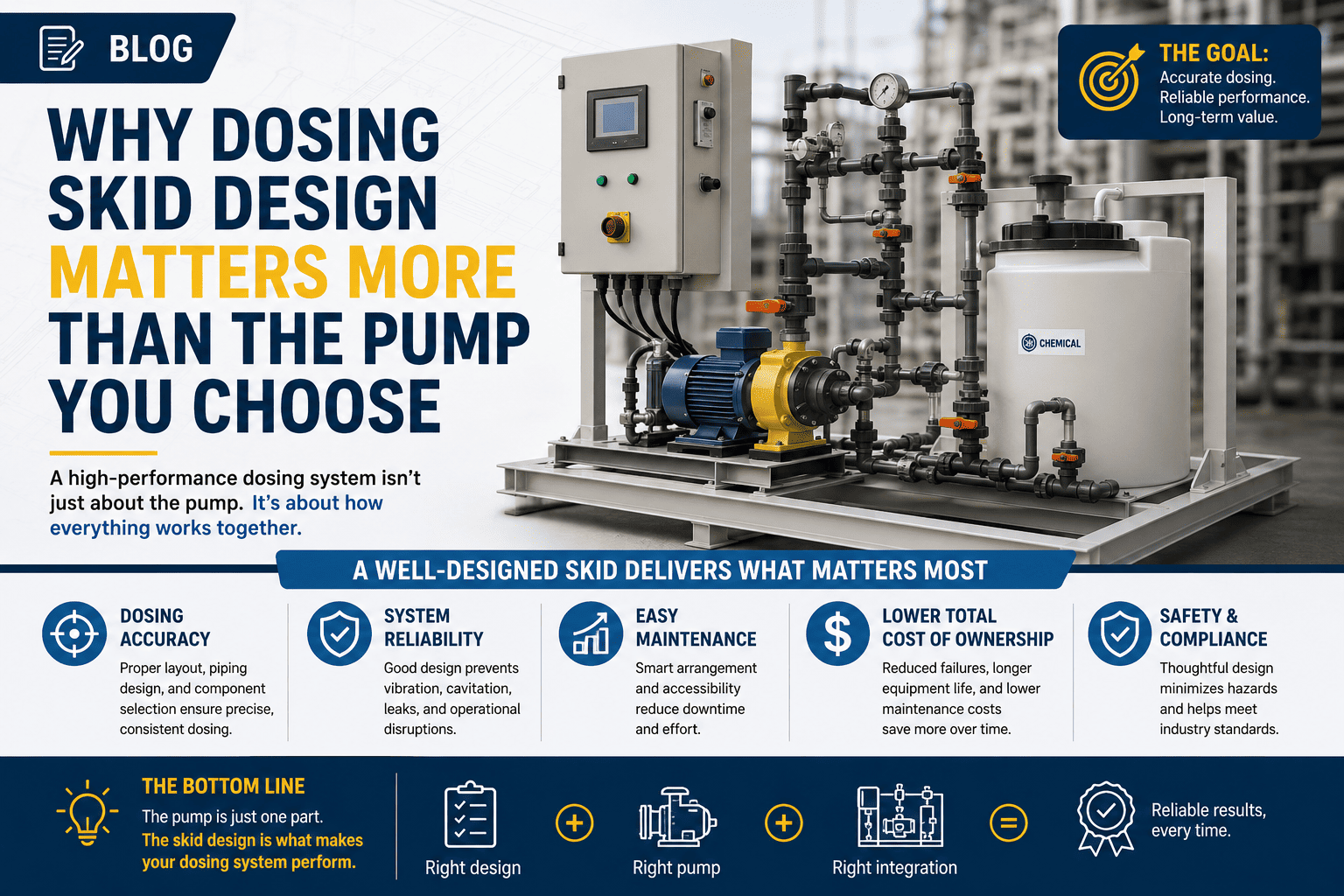
There’s a common pattern in water treatment and industrial process plants: the pump gets specified carefully, sourced from a reputable brand, sized correctly for the duty point — and then the dosing skid it sits on is assembled as an afterthought. The result is a system that works in the factory and causes constant problems on site.
The pump is maybe 30% of what makes a dosing system reliable in service. The other 70% is the design of the skid around it.
What Dosing Skids Actually Do — And Why It’s More Complex Than It Looks
A dosing skid’s job is to introduce a precisely metered quantity of a chemical — a coagulant, a disinfectant, an antiscalant, a pH correction agent — into a process stream at a controlled rate. That sounds simple. The practical reality involves:
- Chemical compatibility between the fluid and every wetted component
- Calibration column sizing for accurate dosing verification
- Day tank capacity and changeover provisions
- Containment for spills and drips — especially for corrosive chemicals
- Accessibility for maintenance, not just for commissioning
Each of these points is a potential failure mode if the skid is designed without operational experience. Most problems we encounter when clients bring us in to troubleshoot existing systems trace back to one of these areas.
Chemical Compatibility Is Not Optional
This is the one that causes the most damage. The wrong material choice for a fitting, a valve body, or a diaphragm can result in premature failure within months of commissioning — or, in aggressive chemical service, within weeks.
Sodium hypochlorite (bleach), for example, attacks certain elastomers and attacks mild steel rapidly. Ferric sulphate is abrasive and corrosive. Antiscalants are generally mild but can interact unexpectedly with certain polymer materials at elevated temperatures.
Every component on a dosing skid — pump heads, tubing, connectors, ball valves, check valves, calibration columns — needs to be confirmed compatible with the specific chemical, concentration, and temperature. This review should be documented, not assumed.
The Calibration Column Problem
Dosing verification is often overlooked until an audit or a process upset makes it urgent. The calibration column — a transparent graduated cylinder in the suction line — allows the operator to verify actual dosing rate against the pump setting.
We’ve seen skids delivered without a calibration column, or with one that’s too small for the pump output range, or installed in a position that makes reading the level while the pump is running physically impossible. Small design decisions with significant operational consequences.
If your dosing skid doesn’t have a properly sized, accessible calibration column, your operators are effectively flying blind on chemical consumption.
Learn more about our dosing skids and process plant solutions
Designing for Maintenance, Not Just Commissioning
A skid that’s well-designed for commissioning and poorly designed for maintenance will create steady problems over its service life. Access for pump diaphragm replacement, valve servicing, and pipe section isolation should be built into the layout — not crammed in after everything else is positioned.
Practical details that matter: Are isolation valves accessible without removing another component? Can the day tank be cleaned without disconnecting the entire suction manifold? Is there a floor drain in the bunded area? Is the control panel legible from the operator’s normal standing position?
These are the questions that separate a skid designed by people who’ve seen systems run in the field from one designed purely on CAD with no operational reference.
Instrumentation — Do You Actually Need That Level of Complexity?
Automation and instrumentation add cost and complexity. Sometimes it’s warranted; sometimes it’s specified because it was on the last project’s BOM without anyone questioning whether it’s needed here.
For a simple pH correction application with a small flow rate and manual operation, a motorised agitator, a level switch on the day tank, and a basic flow-proportional dosing pump is often sufficient. For a large SWRO plant dosing multiple chemicals at variable rates to an automated process, SCADA integration and automatic chemical changeover are probably justified.
The right instrumentation level is the one that matches the complexity of the process and the capability of the operators who’ll run it.
What Good Dosing Skid Procurement Looks Like
When you specify a dosing skid, go beyond pump flow rate and chemical identity. Define the installation environment (indoor/outdoor, ambient temperature range), the operating mode (manual/automatic, continuous/batch), the maintenance access requirements, and the documentation you need for hand-over.
Share your process datasheet or PFD with the supplier. Ask to see a representative GA drawing before the fabrication drawing is finalised. Visit the facility if you can — a fabricator who won’t let you see the shop floor is telling you something.
Our team designs dosing skids from the process requirement up — not from a catalogue of standard assemblies. If you’re scoping a new dosing system or replacing an underperforming one, we’d be glad to review your requirement.
▶ Discuss Your Dosing System Requirement